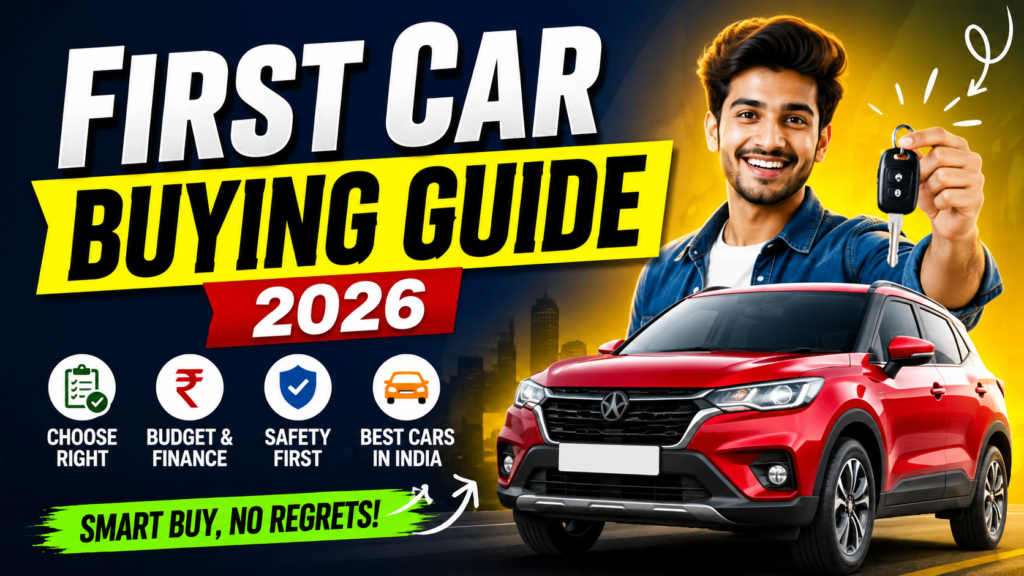
Complete Car Buying Guide for First-Time Buyers in India (2026)
By Kaushik Brahmakshatriya
Published on 02 July 2026.
First car buying guide India
Buying your first car is an exciting milestone, but it can also feel overwhelming with so many models, financing options, and features to consider. Whether you’re a young professional in a metro city or planning your first family car, this guide breaks down everything you need to know before signing that dealership paperwork.
Step 1: Set a Realistic Budget
Financial experts often suggest that your car’s on-road price shouldn’t exceed 50% of your annual income. Don’t forget to factor in insurance, registration, and maintenance costs beyond just the showroom price.
| Monthly Income (₹) | Suggested Car Budget (₹) | Ideal Segment |
| 30,000–50,000 | 5–7 Lakh | Hatchback |
| 50,000–80,000 | 7–12 Lakh | Compact SUV/Sedan |
| 80,000+ | 12 Lakh+ | Mid-size SUV/Premium Sedan |
Step 2: Choose the Right Fuel Type
With rising fuel prices and growing EV infrastructure, fuel choice matters more than ever for first-time buyers.
| Fuel Type | Best For | Average Running Cost |
| Petrol | Low annual mileage (under 10,000 km) | Moderate |
| CNG | High daily commute, budget-conscious buyers | Very Low |
| Electric (EV) | City driving, long-term savings | Lowest (per km) |
| Diesel | High mileage, highway driving | Moderate-High |
Step 3: Compare Loan Offers Carefully
Most first-time buyers rely on car loans. Interest rates, processing fees, and down payment requirements vary significantly across banks and NBFCs, so comparing at least three lenders before finalizing is a smart move. A higher down payment reduces your EMI burden and total interest paid over the loan tenure.
Step 4: Don’t Skip the Test Drive and Inspection
Never finalize a car purely based on brochures or online reviews. Take a test drive across varied road conditions—city traffic, highways, and rough patches—to judge comfort, mileage, and handling firsthand.
Step 5: Essential Checklist Before Delivery
| Checklist Item | Why It Matters |
| Verify VIN and engine number | Prevents fraud or mismatched paperwork |
| Check insurance policy details | Avoid coverage gaps |
| Inspect for delivery scratches/dents | Ensures a flawless first drive |
| Confirm RTO registration process | Avoids legal delays later |
| Review warranty and service package | Saves future repair costs |
| Review warranty and service package | Saves future repair costs |
Final Thoughts
Buying your first car is as much about smart planning as it is about excitement. By setting a clear budget, choosing the right fuel type, comparing loan options, and thoroughly inspecting the vehicle before delivery, first-time buyers in India can avoid common pitfalls and drive away with confidence.
Frequently Asked Questions (FAQs)
Q1. What is the ideal down payment for a first car in India?
A down payment of 20–30% of the car’s on-road price is generally recommended to keep EMIs manageable.
Q2. Is it better to buy a new car or a certified used car as a first vehicle?
For buyers with a tighter budget, a certified used car can offer better value, while new cars provide full warranty and the latest features.
Q3. How long does car loan approval usually take in India?
Most banks and NBFCs approve car loans within 24 to 72 hours, provided documentation is complete.
Q4. Should first-time buyers choose manual or automatic transmission?
City drivers often prefer automatic for convenience in traffic, while manual transmission remains more fuel-efficient and budget-friendly.
Q5. What documents are required to buy a car in India?
Typically required: ID proof, address proof, PAN card, income proof, and passport-size photographs for loan and registration processing.
Disclaimer
The information on this auto blog is for general purposes only. Prices, features, and specifications may change without notice. Please verify details with the official dealer or manufacturer before making any purchase decision. We are not responsible for any loss based on this informational.

Related Posts

Leave a Reply