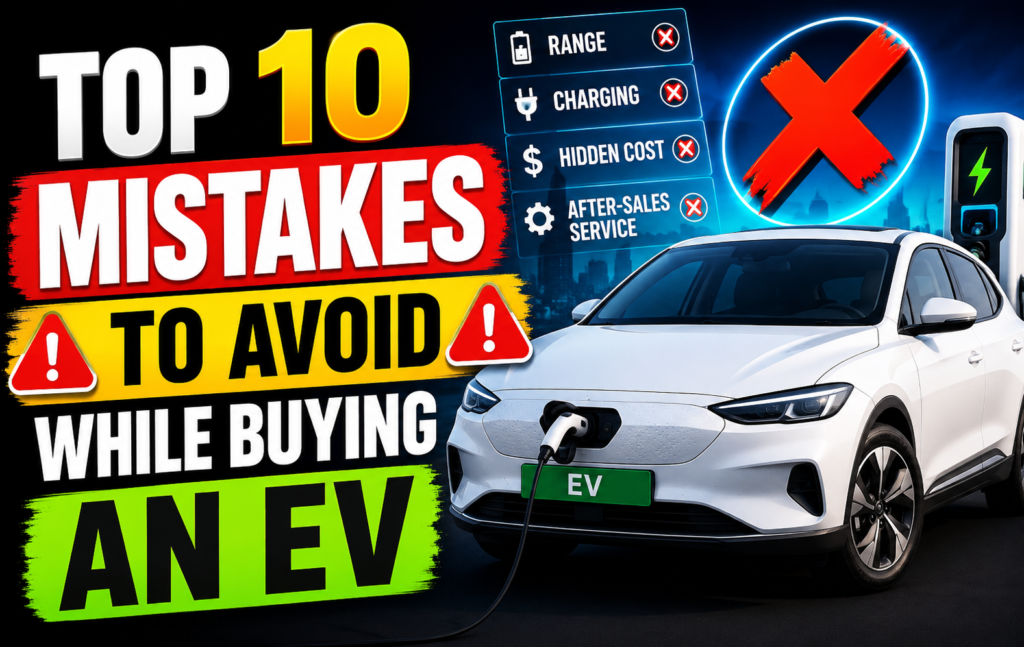
Top 10 Mistakes to Avoid While Buying an EV
By Kaushik Brahmakshatriya
Published On 12 July 2026.
Top 10 mistakes to avoid while buying an EV
Electric vehicles are no longer a niche choice — they’re fast becoming mainstream on Indian roads. But switching from petrol or diesel to electric isn’t as simple as picking a color and driving off the lot. Many first-time buyers end up regretting their purchase because they overlooked a few critical factors. Here are the ten most common mistakes people make when buying an EV, and how you can avoid them.
1. Ignoring Real-World Range vs Claimed Range
Manufacturers often advertise range figures tested under ideal lab conditions. Real-world range — affected by AC usage, traffic, terrain, and driving style — can be 20-30% lower. Always check independent reviews and owner experiences before trusting the brochure number.
2. Not Checking Charging Infrastructure Near You
Buying an EV without confirming charger availability in your city or society is a common regret. Apartment dwellers especially need to check if their housing society allows home charger installation.
3. Underestimating Home Charging Setup Costs
A home charging point requires electrical upgrades, a dedicated meter in some cases, and installation charges that buyers often forget to budget for.
4. Overlooking Battery Warranty Terms
Not all battery warranties are equal. Some cover 8 years/1.6 lakh km, others less. Always compare degradation clauses — a warranty that doesn’t cover capacity loss is far weaker than one that does.
5. Skipping a Test Drive in Real Traffic Conditions
A showroom test drive rarely reflects daily commute conditions. Take a longer test drive in city traffic and, if possible, on a highway stretch to judge acceleration, braking regen, and cabin noise.
6. Not Factoring in Resale Value
The EV resale market in India is still maturing, and battery health heavily influences resale price. Researching how similar EV models have performed in the used market can prevent surprises later.
7. Choosing Battery Size Without Assessing Actual Usage
Buyers often overpay for a bigger battery “just in case,” when their daily driving needs are modest. Calculate your average daily kilometers before deciding on battery capacity.
8. Ignoring Service Network Availability
EVs need specialized service centers, not regular mechanics. Before buying, check how many authorized service centers exist in your city and nearby towns.
9. Not Comparing Total Cost of Ownership (TCO)
Focusing only on the on-road price is a mistake. Calculate the total cost including electricity costs, insurance, maintenance, and battery replacement over 5-8 years to get a true comparison with petrol/diesel vehicles.
10. Falling for Discounts Without Checking Software Updates
Some EVs receive over-the-air (OTA) software updates that improve range and features over time, while others don’t. A heavily discounted model with no OTA support may fall behind quickly.
Comparison Table: Common EV Buying Mistakes and Their Impact
| Mistake | Impact on Buyer | How to Avoid |
| Ignoring real-world range | Frequent range anxiety | Check owner reviews, not just brochures |
| Skipping charging infra check | Daily charging hassle | Confirm charger access before buying |
| Overlooking battery warranty | Costly repairs later | Compare degradation coverage clauses |
Battery Size vs Ideal Use Case
| Battery Size (approx.) | Ideal Daily Usage | Suitable Buyer Type |
| Small (30-40 kWh) | Under 150 km/day | City commuters |
| Medium (40-60 kWh) | 150-250 km/day | Mixed city + highway users |
| Large (60+ kWh) | 250+ km/day | Frequent long-distance travelers |
One-Time vs Recurring EV Ownership Costs
| Cost Type | Examples | Frequency |
| One-time | Home charger installation, registration | Once at purchase |
| Recurring | Electricity bill, insurance, servicing | Monthly/Yearly |
| Long-term | Battery replacement (if out of warranty) | After 6-8 years |
Frequently Asked Questions (FAQ)
Q1. What is the biggest mistake people make when buying an EV?
A. Ignoring real-world range and assuming the claimed range will match daily driving conditions.
Q2. Is home charging installation included in the EV price.
A. Usually not. Installation charges and any electrical upgrades are typically an additional cost buyers must budget for separately.
Q3. How important is battery warranty while choosing an EV?
A. Very important. A warranty that covers capacity degradation, not just manufacturing defects, protects you from expensive battery replacement costs later.
Q4. Should I buy an EV based only on the lowest price?
A. No. Total cost of ownership, service network, and resale value matter more in the long run than just the upfront price.
Q5. Do all EVs get software updates after purchase?
A. No, this varies by manufacturer. Models with OTA updates tend to improve over time, while others may lack new features or range optimizations.
Disclaimer :
Information on this auto blog is for general purposes only. Prices, features, and specifications may change without notice. Please verify details with the official dealer or manufacturer before making any purchase decision. We are not responsible for any loss based on this informational.



Leave a Reply