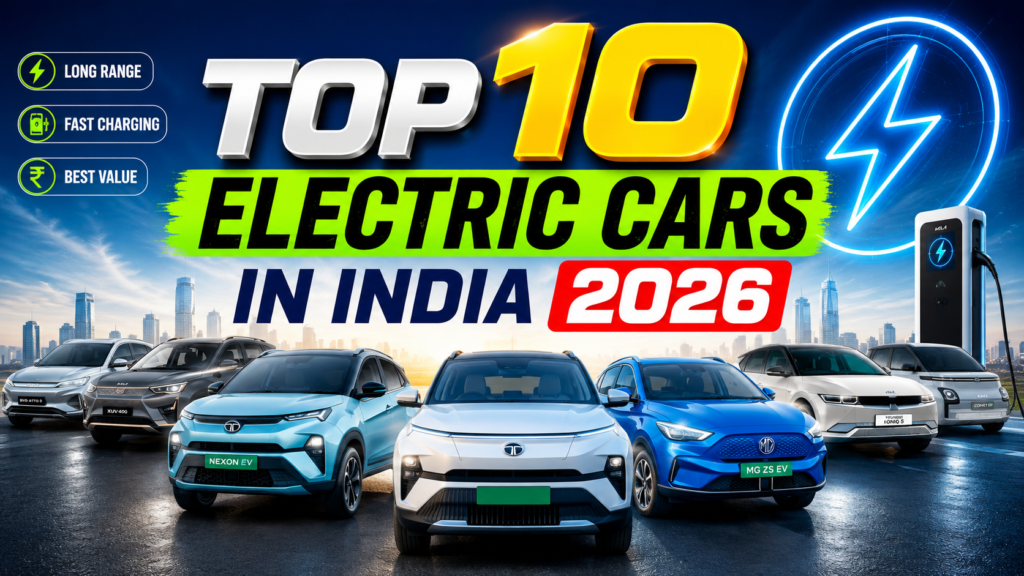
Top 10 Electric Cars in India 2026: Price, Real-World Range & FAME 3 Subsidy Guide
By Kaushik Brahmakshatriya
Published On 14 May 2026.
Top 10 electric cars in India 2026
India’s electric vehicle market is no longer a promise — it is a reality. With over 2 million units projected to be sold by the end of 2026, Indian buyers now have genuine, feature-rich choices across every budget segment. Whether you commute 40 km daily in Ahmedabad traffic or plan weekend highway drives, today’s EVs can handle it all.
This guide brings you the Top 10 Electric Cars in India 2026 with verified ex-showroom prices, honest real-world range figures, and a clear breakdown of FAME 3 subsidy benefits — so you make a smarter buying decision.
What Is the FAME 3 Subsidy in India 2026?
The Faster Adoption and Manufacturing of Electric Vehicles (FAME) Phase 3 scheme is the Government of India’s flagship EV incentive programme with an allocated budget of ₹10,000 crore. Under FAME 3, buyers can save up to ₹50,000–₹1 lakh on eligible electric cars. The subsidy is applied directly at the point of sale — no separate application needed.
Additionally, state-level incentives can push total savings even higher:
| State | EV Car Subsidy | Road Tax & Registration |
| Delhi | Up to ₹1.5 Lakh | 100% Exempt |
| Maharashtra | Up to ₹2.5 Lakh | Exempt + Scrapping Incentive |
| Gujarat | Up to ₹1.5 Lakh | 50% Reduction |
| Tamil Nadu | Up to ₹1 Lakh | 100% Exempt |
| Rajasthan | Up to ₹1 Lakh | 100% Exempt |
Key Benefit: Electric cars attract only 5% GST compared to 28%+ on petrol/diesel vehicles. Combined savings can reach ₹1.5–3 lakh on a mid-range EV.
Top 10 Electric Cars in India 2026 — Price & Range Comparison
| # | Car Model | Ex-Showroom Price | Real-World Range | Battery Size |
| 1 | MG Comet EV | ₹6.31 – ₹8.82 Lakh | ~170–190 km | 17.3 kWh |
| 2 | Tata Tiago EV | ₹7.99 – ₹11.14 Lakh | ~200–240 km | 24 kWh |
| 3 | Tata Punch EV | ₹7.99 – ₹11.14 Lakh | ~280–300 km | 24 kWh |
| 4 | MG Windsor EV | ₹12.04 – ₹17 Lakh | ~280–320 km | 38 kWh |
| 5 | Maruti e Vitara | ₹13.49 – ₹21 Lakh | ~330–430 km | 49–61 kWh |
| 6 | Hyundai Creta Electric | ₹17 – ₹23 Lakh | ~310–360 km | 42–51.4 kWh |
| 7 | Tata Curvv EV | ₹17.49 – ₹22.24 Lakh | ~300–365 km | 45–55 kWh |
| 8 | Mahindra BE 6 | ₹18.90 – ₹28.49 Lakh | ~380–449 km | 45–55 kWh |
| 9 | MG ZS EV | ₹18.98 – ₹25.75 Lakh | ~380–449 km | 59–79 kWh |
| 10 | Mahindra XEV 9e | ₹21.90 Lakh onwards | ~400–460 km | 59–79 kWh |
Detailed Look at Each Car
1. MG Comet EV — Best for City Commuters
India’s most affordable electric car, the MG Comet EV, is ideal for tight city roads and short daily commutes. Its 17.3 kWh battery delivers a real-world range of around 170–190 km, enough for urban driving. Features include dual 10.25-inch screens, wireless Android Auto/Apple CarPlay, and connected car tech.
Best For: Solo city commuters | Starting Price: ₹6.31 Lakh
2. Tata Tiago EV — Budget EV with Decent Range
The Tata Tiago EV remains the best entry-level family electric car under ₹12 lakh. With a 24 kWh battery, real-world range sits comfortably between 200–240 km. It packs Tata’s Z+ safety architecture and a 7-inch touchscreen infotainment system.
Best For: Budget buyers, small families | Starting Price: ₹7.99 Lakh
3. Tata Punch EV — India’s Bestselling EV
India’s monthly EV sales chart is regularly topped by the Tata Punch EV. Priced from ₹8.09 lakh, it delivers a claimed 421 km range, with real-world tests landing at 280–300 km. Its 120 PS motor handles city stop-go traffic with ease. Post FAME 3 subsidy, effective prices can dip below ₹9 lakh in several states.
Best For: Families, daily commuters | Starting Price: ₹8.09 Lakh
4. MG Windsor EV — The Living Room on Wheels
The MG Windsor EV redefined value in the mid-segment with its couch-like rear seating, large panoramic roof, and a 38 kWh battery delivering ~280–320 km real-world range. Available via BaaS (Battery as a Service), its upfront cost is further reduced.
Best For: Family comfort, highway drives | Starting Price: ₹12.04 Lakh
5. Maruti Suzuki e Vitara — Reliability Meets Electric
India’s favourite car brand entered the EV space with the e Vitara, backed by the HEARTECT-e dedicated EV platform and a 5-star Bharat NCAP rating. The 61 kWh variant claims 543 km ARAI range; real-world numbers hover around 380–430 km. The e Vitara is available in 2WD and all-wheel drive options.
Best For: Highway travel, safety-conscious buyers | Starting Price: ₹13.49 Lakh
6. Hyundai Creta Electric — Smart SUV with Korean Polish
Hyundai’s electric Creta carries the beloved Creta DNA with two battery pack options (42 kWh and 51.4 kWh). Real-world range is approximately 310–360 km. Its Level 2 ADAS, panoramic sunroof, and premium interior set it apart in the mid-segment EV space.
Best For: Tech-focused buyers, urban SUV buyers | Starting Price: ₹17 Lakh
7. Tata Curvv EV — Coupe Style with Substance
The Tata Curvv EV blends sporty coupe-SUV design with 45 kWh and 55 kWh battery options. Real-world combined range in Autocar India tests showed around 365 km for the 55 kWh variant — a solid result. The Curvv EV also earned a 5-star BNCAP safety rating, making it one of the safest EVs in India.
Best For: Style-conscious buyers, young families | Starting Price: ₹17.49 Lakh
8. Mahindra BE 6 — Performance EV of the Year
Built on Mahindra’s born-EV INGLO platform, the BE 6 is a performance coupe-SUV unlike anything else on Indian roads. The top 79 kWh variant posted 449 km real-world range in independent tests — highest in its segment. With 286 PS and 380 Nm of torque, it does 0–100 km/h in around 6.7 seconds.
Best For: Performance seekers, EV enthusiasts | Starting Price: ₹18.90 Lakh
9. MG ZS EV — Proven, Feature-Packed Midsize EV
The MG ZS EV is a well-established electric SUV with a loyal buyer base. Its 50.3 kWh battery delivers real-world range of around 330–390 km, with features like a panoramic roof, ADAS driver assistance, and a premium connected car experience.
Best For: Tech buyers wanting a proven EV | Starting Price: ₹18.98 Lakh
10. Mahindra XEV 9e — Premium EV with Flagship Range
The XEV 9e shares its INGLO platform and 59/79 kWh battery options with the BE 6 but offers more SUV roominess and premium cabin features. Real-world range of 400–460 km makes it one of the longest-range mass-market EVs in India.
Best For: Premium buyers, long-distance drivers | Starting Price: ₹21.90 Lakh
FAME 3 Subsidy: Estimated Savings on Top EVs
| Car Model | Base Price | Est. FAME 3 + State Savings* | Effective Price |
| Tata Punch EV | ₹8.09 Lakh | ₹1–1.5 Lakh | ~₹6.6–7 Lakh |
| MG Windsor EV | ₹12.04 Lakh | ₹50K–1 Lakh | ~₹11–11.5 Lakh |
| Maruti e Vitara | ₹13.49 Lakh | ₹50K–1.5 Lakh | ₹12–13 Lakh |
| Hyundai Creta Electric | ₹17 Lakh | ₹50K–1 Lakh | ~₹16–16.5 Lakh |
| Mahindra BE 6 | ₹18.90 Lakh | ₹50K–1 Lakh | ~₹17.9–18.4 Lakh |
*Savings vary by state. Consult your dealer for exact post-subsidy pricing.
Frequently Asked Questions (FAQ)
Q1. Which is the best electric car under ₹10 lakh in India 2026?
The Tata Punch EV (starting ₹8.09 lakh) is the top choice under ₹10 lakh, offering the best combination of real-world range (~280–300 km), safety, and features. The Tata Tiago EV is an excellent budget alternative.
Q2. Is FAME 3 subsidy available on all electric cars in India?
FAME 3 currently focuses primarily on electric two-wheelers, three-wheelers, and buses. For electric cars, benefits are available for models priced below ₹15 lakh. State-level subsidies like Delhi’s ₹1.5 lakh and Maharashtra’s ₹2.5 lakh are available across a wider range of EVs.
Q3. What is the real-world range of the Mahindra BE 6?
In independent real-world tests by Autocar India, the Mahindra BE 6 (79 kWh) achieved a combined range of 449 km, which is 234 km less than its ARAI-claimed 683 km. Real-world range always varies based on speed, AC usage, and load.
Q4. Which electric car has the longest real-world range in India 2026?
The Mahindra XEV 9e and Mahindra BE 6 (79 kWh versions) lead with ~400–460 km real-world range, followed closely by the Maruti e Vitara (61 kWh) at ~380–430 km.
Q5. Is GST reduced for electric cars in India?
Yes. Electric cars attract only 5% GST in India, compared to 28% GST plus cess on petrol and diesel vehicles. This makes the ownership cost of EVs significantly lower over time.
Q6. Which state gives the highest subsidy on electric cars in India?
Maharashtra offers the highest state-level EV subsidy — up to ₹2.5 lakh for electric cars — along with road tax exemption and an additional scrapping incentive. Delhi follows with up to ₹1.5 lakh and full registration exemption.
Q7. Is Battery as a Service (BaaS) a good option for EV buyers?
BaaS reduces the upfront purchase price significantly (by 20–30%) since you don’t buy the battery — you pay a monthly rental instead. It works well for city commuters with predictable mileage. The MG Windsor EV and Tata Punch EV both offer BaaS options in 2026.
Final Verdict
India’s EV market in 2026 offers something for every type of buyer — from the city-friendly MG Comet EV at ₹6.31 lakh to the performance-packed Mahindra BE 6 and the range-dominant XEV 9e. When you combine FAME 3 incentives with state-level subsidies and the 5% GST benefit, buying an electric car in India has never made more financial sense.
The Tata Punch EV remains the safest all-rounder bet for most Indian families, while the Mahindra BE 6 is the clear winner for those who want driving excitement and maximum range.
Disclaimer :
The information on this auto blog is for general purposes only. Prices, features, and specifications may change without notice. Please verify details with the official dealer or manufacturer before making any purchase decision. We are not responsible for any loss based on this informational .



Leave a Reply