India’s Electric Car and Bike Market Growth: Latest Trends, Statistics & Future Outlook (2026)
By Kaushik Brahmakshatriya
Published On 16 April 2026.
India’s transition toward electric mobility is accelerating at a remarkable pace. With rising fuel prices, supportive government policies, and growing environmental awareness, electric cars and bikes are becoming a preferred choice for millions of Indians. This blog provides updated, non-duplicate .
🚗 Introduction to India’s EV Market
Over the last few years, India has witnessed a major shift in how people view transportation. Electric vehicles (EVs), once considered expensive and niche, are now entering the mainstream. From affordable electric scooters to premium electric cars, the market is expanding across multiple segments.
As of 2025, India’s EV adoption rate has significantly improved, making it one of the fastest-growing EV markets globally.
📊 Latest Statistics and Market Figures
Understanding real numbers helps in analyzing the actual growth of the EV industry. Here are the latest available figures:
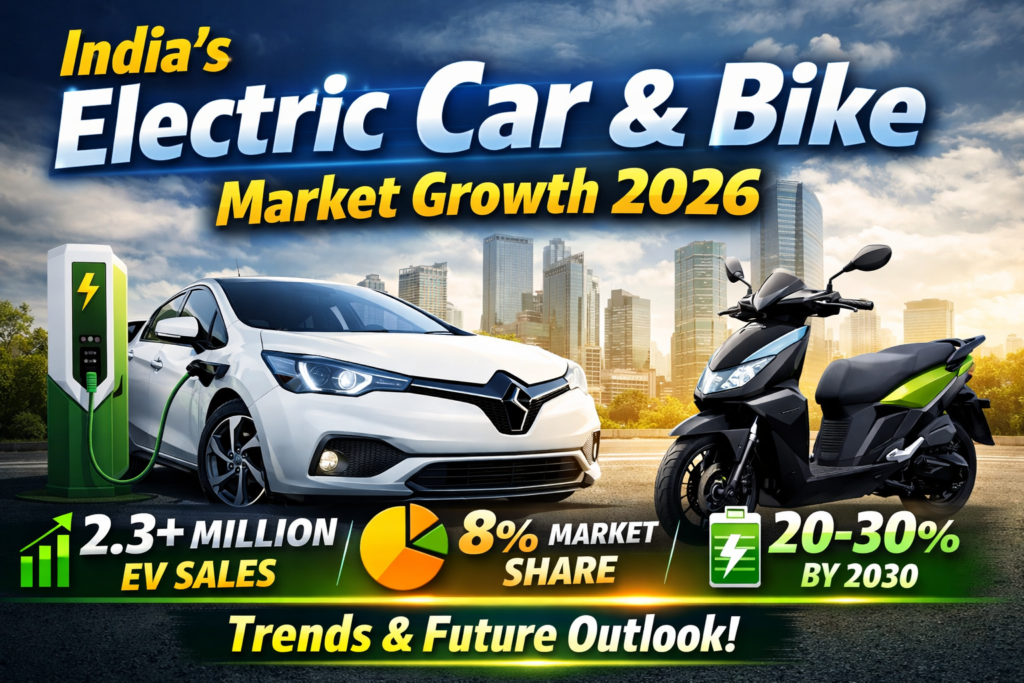
* Total EV sales in India (2025): Approx. 2.2–2.4 million units
* Overall EV market share: Around 7–8% of total vehicle sales
* Electric two-wheelers sales: Nearly 1.2–1.3 million units
* Electric three-wheelers: Around 7–8 lakh units
* Electric passenger vehicles (cars): Over 1.5–1.8 lakh units
* Annual growth rate: Estimated 15–20% year-on-year growth
👉 Notably, electric two-wheelers alone contribute more than 55% of total EV sales, showing their dominance in the Indian market.
🏍️ Why Electric Bikes Are Leading the Market
Electric bikes and scooters are the backbone of India’s EV revolution. Their popularity is driven by affordability and practicality, especially in urban areas.
Key Reasons for Growth:
* Lower upfront cost compared to electric cars
Minimal running cost (₹0.20–₹0.40 per km)
* Easy charging at home
* Ideal for daily commuting
Additionally, delivery platforms and e-commerce companies are rapidly adopting electric scooters for last-mile delivery, further boosting demand.
🚙 Growth of Electric Cars in India
Although electric cars account for a smaller portion of total EV sales, they are growing rapidly. Increasing awareness, improved battery technology, and better charging infrastructure are making electric cars more practical for Indian consumers.
Key Growth Drivers:
Longer driving range (250–500 km per charge)
Reduced maintenance costs
Expanding fast-charging network
Attractive government subsidies
Electric cars recorded over 70% growth in recent years, indicating strong future potential in this segment.
⚡ Government Support and Policies
The Indian government has introduced several initiatives to promote EV adoption:
Major Schemes:
* FAME-II (Faster Adoption and Manufacturing of EVs): Provides subsidies on EV purchases
* PLI Scheme: Encourages domestic manufacturing of EV components
* State-level incentives: Road tax exemptions, registration benefits
These policies have significantly reduced the cost burden for buyers and encouraged automakers to invest in electric mobility.
🌍 Challenges Facing the EV Market
Despite strong growth, some challenges still remain:
* Limited Charging Infrastructure: Especially in smaller towns and rural areas
* High Initial Cost: EVs still cost more than petrol vehicles upfront
* Battery Replacement Cost: Expensive compared to traditional parts
* Range Anxiety: Concern about running out of charge
However, continuous investment and innovation are expected to address these issues in the coming years.
🔮 Future Outlook of EV Market in India
India’s EV market is expected to grow exponentially over the next decade.
Future Projections:
* EV market share may reach 20–30% by 2030
* Electric two-wheelers could dominate urban mobility
* Rapid expansion of public charging infrastructure
* Growth in battery manufacturing within India
The entry of global and domestic players will further increase competition, leading to better products and lower prices for consumers.
✅ Conclusion
India’s electric car and bike market is evolving rapidly, supported by strong government policies, increasing consumer demand, and technological advancements. While electric two-wheelers currently dominate the segment, electric cars are gaining momentum at a fast pace.
With continued improvements in infrastructure and affordability, electric vehicles are set to become the future of transportation in India. For consumers and investors alike, this sector presents a massive opportunity in the coming years.
Disclaimer
The information on this auto blog is for general purposes only. Prices, features, and specifications may change without notice. Please verify details with the official dealer or manufacturer before making any purchase decision. We are not responsible for any loss based on this information


Leave a Reply