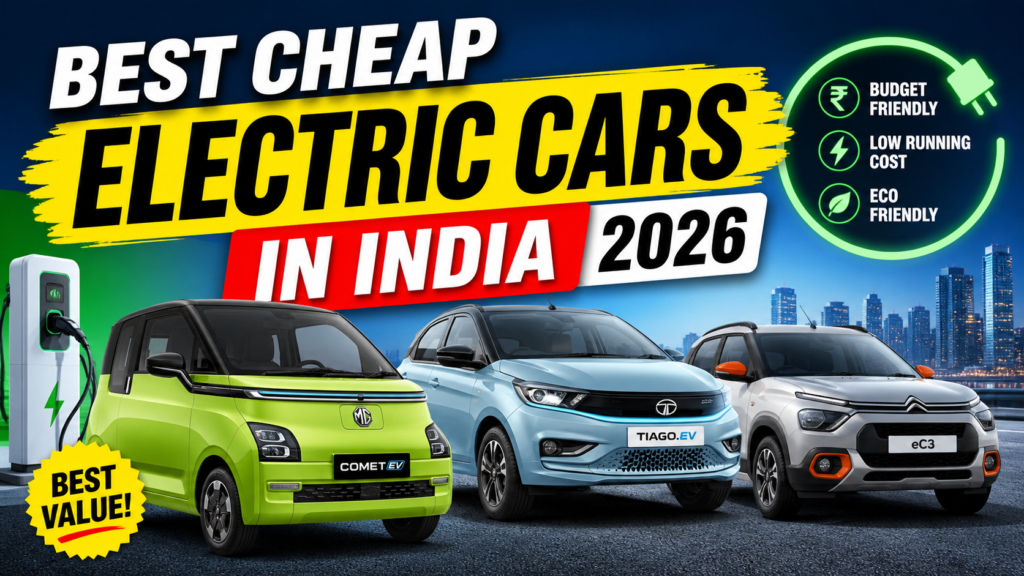
Best Cheap Electric Cars in India 2026: 5 EVs That Won’t Break Your Bank
By Kaushik Brahmakshatriya
Published On 03 May 2026.
Cheapest electric car in India 2026
India’s electric vehicle revolution is no longer just for the rich. In 2026, you can drive electric for less than ₹8 lakh — and in some cases, even less than ₹4 lakh. But with so many new names flooding the market, figuring out which affordable EV actually makes sense to buy has become genuinely confusing.
This guide cuts through the noise. We have picked the five cheapest electric cars available in India right now — and we will tell you honestly who each one is best suited for, because the right EV for a college student in Ahmedabad is very different from the right EV for a family of four in Delhi.
The Real Cost of Not Switching to Electric
Before the list — a quick reality check that most car buyers overlook.Driving a petrol car in India’s cities typically costs between ₹6 and ₹8 per kilometre once you factor in fuel, servicing, and consumables. An EV brings that number down to roughly ₹1 to ₹2 per kilometre — sometimes even lower if you charge at home overnight.
Over 30,000 km a year, that is a saving of nearly ₹1.5 lakh annually just on running costs. That gap, combined with the 5% GST rate on EVs versus 28% on petrol cars, is why more Indian buyers are looking at electric even at entry-level price points.
5 Cheapest Electric Cars in India — 2026 Edition
1. Vayve Mobility Eva — From ₹3.25 Lakh
The one that changes the conversation entirely.
Nobody expected an Indian startup to launch a solar-assisted electric car at this price point, yet Vayve Mobility’s Eva exists — and its pre-bookings are already closed. The Eva is a narrow, city-specific vehicle designed for one or two occupants, measuring under 3.1 metres in length. The roof-mounted solar panel top up the battery during daylight, reducing charging frequency for typical urban commutes.
This is not a highway car. Think of it as the smartest solution to last-mile and daily office travel — parked in tight spaces, charged without a dedicated EV point, and cheaper to run than a two-wheeler over time.
Price: ₹3.25 Lakh onwards
Range: ~100 km (city)
Ideal buyer: Solo commuters, first-time EV owners, students
2. MG Comet EV — From ₹6.99 Lakh
Small car, surprisingly big on features.
The MG Comet EV looks unconventional but solves a very specific Indian problem — city parking. At under 3 metres, it slips into gaps that regular hatchbacks cannot. Inside, the cabin quality is noticeably better than the price suggests, and the connected car features feel premium.
The honest trade-off: rear seat access is awkward, boot space is limited when all seats are occupied, and it is not built for anything beyond city limits. There is also no fast charging support, so overnight home charging is your primary option.
If your driving life is entirely within one city and you cover under 50 km daily, the Comet EV is a smart, stylish choice.
Price: ₹6.99 – ₹9.24 Lakh
Range: ~230 km (city cycle)
Ideal buyer: Urban singles or couples who hate parking stress
3. Tata Tiago EV — From ₹7.99 Lakh
The one that made affordable EVs respectable in India.
When the Tiago EV launched, it proved that going electric did not mean giving up on practicality. Five adults fit comfortably. The higher variants offer genuine highway capability. Multiple drive modes — including a Sport setting — make it more engaging to drive than you would expect from a budget hatchback.
The lower trims with the smaller battery pack do have limited range, so spend a little more and get the larger battery variant if you plan any inter-city travel. Missing alloy wheels and a basic touchscreen in base variants are areas where corners are clearly cut.
Price: ₹7.99 – ₹11.89 Lakh
Range: Up to ~250 km
Ideal buyer: Nuclear families wanting a reliable, practical first EV
4. Tata Punch EV — From ₹9.69 Lakh
The sweet spot that most buyers end up choosing.
Ask any EV owner in India’s Tier-1 and Tier-2 cities what they would recommend under ₹12 lakh, and the Punch EV comes up repeatedly. It offers a claimed range of up to 350 km, a proper compact SUV stance, segment-best features, and the peace of mind that comes with Tata’s extensive service network.
It costs a little more than the Tiago EV but gives you meaningfully more range, more road presence, and a sense that it was designed from the ground up to be electric — not converted from a petrol model.
Price: ₹9.69 Lakh onwards
Range: 260 – 350 km
Ideal buyer: Anyone who wants the best all-round budget EV without compromise
5. MG Windsor EV — From ₹14 Lakh
Stretching the budget for considerably more car.
The Windsor EV sits at the upper edge of what most people would call “budget” — but it earns its place here because the gap between ₹10 lakh and ₹14 lakh in feature quality and range is significant. The Windsor offers over 330 km of real-world range, a more spacious cabin, and a strong MG after-sales support system.
If you are buying your family’s only car and plan to use it for occasional highway trips, the Windsor EV is worth the stretch over the smaller options.
Price: ₹14 Lakh onwards
Range: ~330 – 449 km
Ideal buyer: Buyers who want premium features without crossing ₹15 lakh
Which Cheap EV Should You Actually Buy?
Here is a simple decision framework:
If your budget is under ₹5 lakh and
you commute solo within a city → Vayve Eva
If you want city convenience and style for under ₹10 lakh → MG Comet EV
If you need a proper 5-seater family hatchback → Tata Tiago EV
If you want the best value EV with proper range → Tata Punch EV (the clear winner for most buyers)
If you can stretch to ₹14 lakh for a more complete package → MG Windsor EV
3 Things Nobody Tells You Before Buying a Budget EV in India
1. Home charging changes everything. If your housing society allows EV charging installation, your daily running costs drop dramatically. If it does not — factor in public charging costs before buying.
2. Entry variants often disappoint on range. Many buyers choose the base model to save money, then regret the limited range. Always check the range of the specific variant you are buying.
3. State subsidies can reduce costs further. Gujarat, Maharashtra, and Delhi offer additional EV purchase incentives beyond the central 5% GST benefit. Check your state transport department’s website before finalising your purchase.
Frequently Asked Questions
Q: Which is the absolute cheapest electric car in India in 2026?
The Vayve Mobility Eva, priced from ₹3.25 lakh, is currently India’s most affordable electric car — though it is a narrow, two-seat solar-assisted city vehicle rather than a conventional family car.
Q: Which budget EV offers the best range in India?
Among cars under ₹12 lakh, the Tata Punch EV delivers the longest range — up to 350 km on a full charge in its top variant.
Q: Is charging infrastructure good enough in Indian cities to buy an EV in 2026?
In major metro cities and state capitals, yes. Tier-2 and Tier-3 cities are improving rapidly. Home charging remains the most practical solution for daily users.
Q: How much does it cost to charge a budget EV at home in India?
Home electricity tariffs in most Indian states range from ₹7 to ₹10 per unit. A typical 30 kWh battery costs roughly ₹210 to ₹300 for a full charge — enough for 200+ km of driving.
Q: Do budget EVs in India come with a battery warranty?
Yes. Most major brands including Tata and MG offer a battery warranty of 8 years or 1.6 lakh kilometres, whichever comes first.
DISCLAIMER :
The information on this auto blog is for general purposes only. Prices, features, and specifications may change without notice. Please verify details with the official dealer or manufacturer before making any purchase decision. We are not responsible for any loss based on this information

Leave a Reply