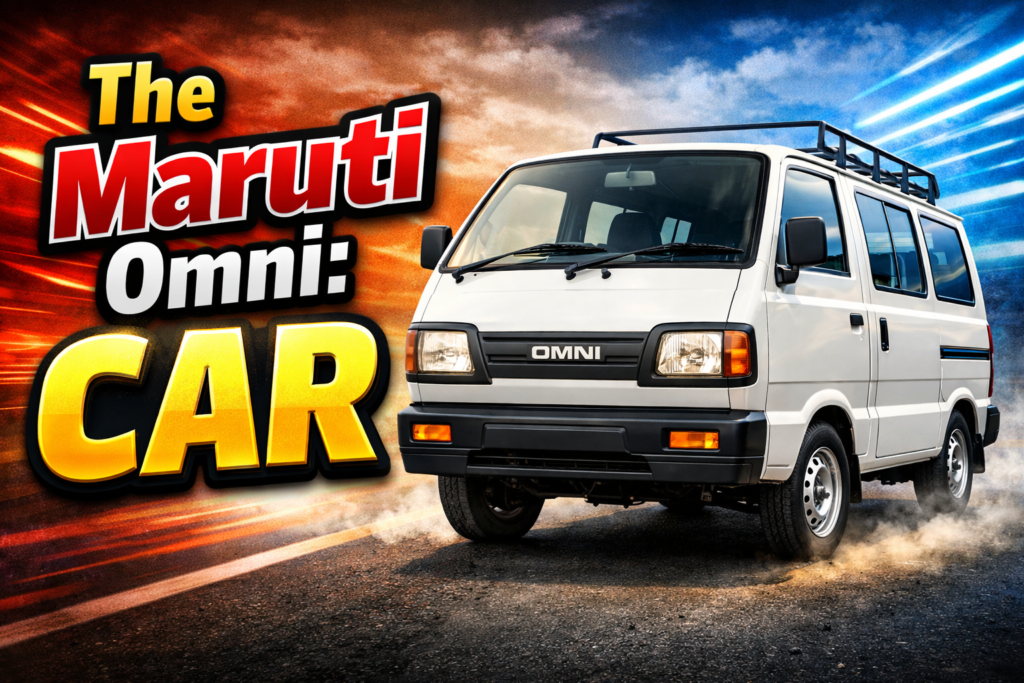
The Maruti Omni: India’s Legendary “Box on Wheels” that Defined a Generation
05, February 2026. By -Kaushik
For over three decades, the Maruti Omni was more than just a vehicle on Indian roads; it was a cultural icon, a reliable business partner, and a core memory for millions. Launched in 1984 as the “Maruti Van” and rebranded as the Omni in 1988, this unassuming microvan became the backbone of Indian middle-class mobility.
Designed for Pure Practicality
The Omni’s design philosophy was simple: maximum space with a minimum footprint. Based on the Suzuki Carry, its “cab-over” design—where the driver sits directly above the front wheels—allowed for an incredibly spacious interior despite its tiny exterior dimensions.
Its most defining feature was the sliding rear doors. In the cramped, narrow lanes of Indian cities, these doors were a masterstroke of engineering, allowing passengers to exit and enter even in the tightest parking spots. Whether it was being used as a family car, a school van, or a cargo carrier, the Omni’s versatility was unmatched.
Minimal Specs, Maximum Durability
Under the front seats sat a humble 796cc, 3-cylinder petrol engine, the same reliable heart found in the legendary Maruti 800. While its power figures were modest—roughly 34 to 37 bhp—it was enough to ferry eight people or a mountain of cargo through city traffic.
Feature Specification
Engine 796cc, 3-Cylinder
Transmission 4-Speed Manual
Power ~35 bhp @ 5000 rpm
Torque 59 Nm @ 2500 rpm
Seating 5-seater / 8-seater / Cargo / Ambulance
The beauty of the Omni lay in its mechanical simplicity. It had no power steering, no air conditioning as standard, and very few electronic sensors. This made it “mechanic-friendly”—any roadside garage in India could fix an Omni with basic tools and affordable spare parts.
Cultural Icon: From School Vans to Bollywood
The Omni wore many hats during its 35-year production run. For the 90s generation, it was the ubiquitous school van, often packed with twice as many children as the manual suggested. For small business owners, it was the ultimate“meals on wheels” or delivery vehicle. In the medical sector, the Omni served as the most common ambulance in rural and urban India alike.
Ironically, the Omni also gained a darker reputation in pop culture. Thanks to countless Bollywood thrillers, its sliding doors and tinted windows made it the “official kidnapping car” of the silver screen—a trope that became a running joke among Indian car enthusiasts.
An Era Comes to an End
In 2019, Maruti Suzuki finally pulled the plug on the Omni. The decision wasn’t due to a lack of demand—it was still selling thousands of units monthly—but due to evolving safety and emission norms.
The flat-front design that made it so spacious also meant there was no “crumple zone” to protect occupants in a head-on collision. Additionally, fitting it with modern essentials like airbags and ABS would have required a total structural redesign. Rather than forcing a makeover, Maruti decided to let the legend retire, passing the baton to the Maruti Eeco.
Final Verdict
The Maruti Omni wasn’t about luxury or speed; it was about democratizing transport. It was a vehicle that helped build businesses and carried families to their first vacations. While it may no longer be in showrooms, its boxy silhouette remains a permanent fixture in the history of the Indian automotive revolution.
Disclaimer :
This content was generated automatically using AI. It is provided for informational purposes only and may contain inaccuracies. Please verify important information independently.”

Related Posts

Leave a Reply