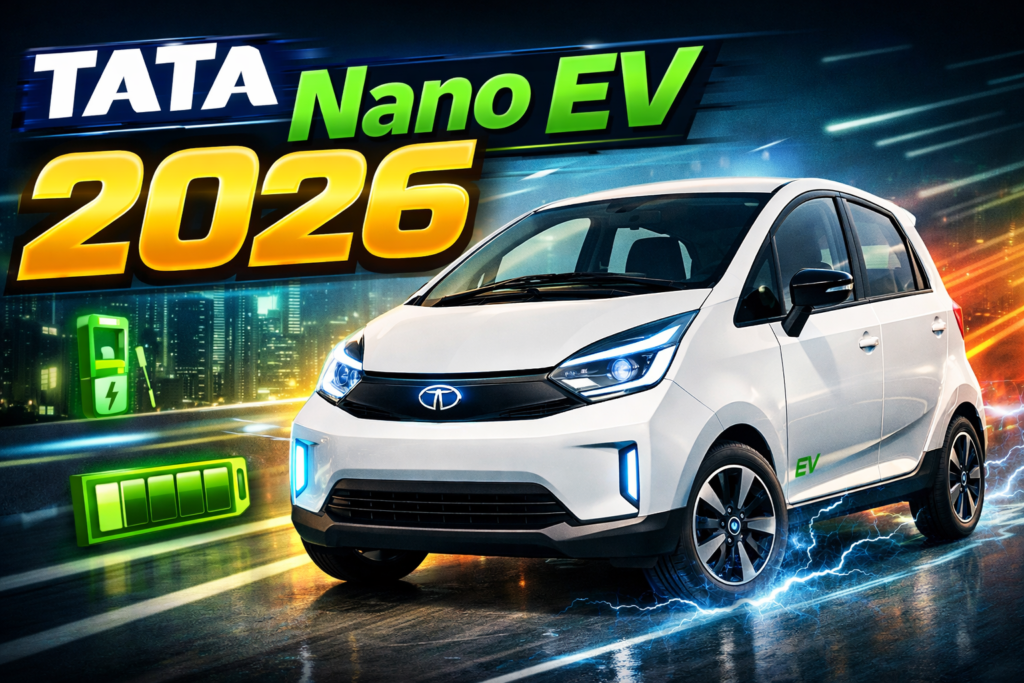
Tata Nano EV 2026 Key Highlights & Expectations
16, January 2026. By -Kaushik
The “People’s Car” is set for an electric rebirth. For years, the Tata Nano was the symbol of affordable mobility in India. Now, as the world shifts toward sustainable energy, rumors and industry reports suggest that Tata Motors is preparing to launch the Tata Nano EV.
Positioned to be the most affordable electric vehicle (EV) in the country, the Nano EV aims to solve the urban commute crisis with its compact size and zero-emission powertrain. If you are looking for a budget-friendly city car, here is everything you need to know about the upcoming Tata Nano EV.
Key Highlights of the Tata Nano EV
The 2026 iteration of the Nano is expected to be more than just a battery-swapped version of the old hatchback. It will likely be built on Tata’s advanced Acti.ev or Ziptron architecture, ensuring better safety and performance.
1. Range and Battery Performance
One of the most critical aspects of an EV is how far it can go. The Nano EV is expected to come with two battery pack options:
Standard Range: A 17–20 kWh battery providing roughly 200 km of range, perfect for daily office runs.
Long Range: Speculations suggest a higher variant with a 25 kWh battery, pushing the range closer to 300 km on a single charge.
2. Compact and Modern Design
While it will retain the iconic “tall-boy” silhouette that made the original Nano so spacious inside, the EV version will feature:
LED DRLs and sleek projector headlamps.
A closed-off front grille for better aerodynamics.
Modern, sporty wheel covers or light alloy wheels.
3. Smart Interiors & Technology
Inside, the Nano EV is expected to move away from its “budget” roots. Expect a cabin equipped with:
A 7-inch touchscreen infotainment system with Android Auto and Apple CarPlay.
A fully digital instrument cluster to monitor battery percentage and range.
Electric power steering and automatic climate control for a premium driving experience.
4. Safety First
Tata Motors has led the “Safe Cars for India” movement, and the Nano EV will be no exception. It is expected to feature:
Dual Airbags and ABS with EBD as standard.
A reinforced body structure to meet modern crash test norms.
Rear parking sensors and a camera for effortless parking in tight city spots.
Expected Price and Launch Date
The Tata Nano EV is rumored to launch by mid-2026. While official pricing hasn’t been announced, industry experts predict a disruptive price range:
Starting Price: Approximately ₹3.5 Lakh to ₹5 Lakh.
Top Variant: Around ₹7 Lakh.
This pricing would make it significantly cheaper than the Tata Tiago EV or the MG Comet, potentially making it the highest-selling electric car in the Indian market.
Why the Nano EV is the Perfect City Car
Parking Friendly: Its tiny footprint means you can park where SUVs only dream of fitting.
Low Running Cost: With electricity being cheaper than petrol, your monthly “fuel” bill could drop by up to 80%.
Zero Noise: The silent electric motor provides a stress-free driving experience in noisy traffic.
Comparison Table: Nano EV vs. Competitors
Feature Tata Nano EV (Expected) MG Comet EV Tata Tiago EV
Est. Price ₹3.5 – 7 Lakh ₹6.99 – 9 Lakh ₹7.99 – 11 Lakh
Range 200–300 km 230 km 250–315 km
Battery 17–25 kWh 17.3 kWh 19–24 kWh
The Verdict: The Tata Nano EV is not just a car; it’s a solution for the middle-class Indian family looking to switch to green energy without breaking the bank.
Disclaimer :
This content was generated automatically using AI. It is provided for informational purposes only and may contain inaccuracies. Please verify important information independently.”



Leave a Reply