Petrol vs Diesel vs EV: Which Is Best in India 2026? The Smart Buyer’s Complete Guide
By Kaushik Brahmakshatriya
Published On 27 October 2026.
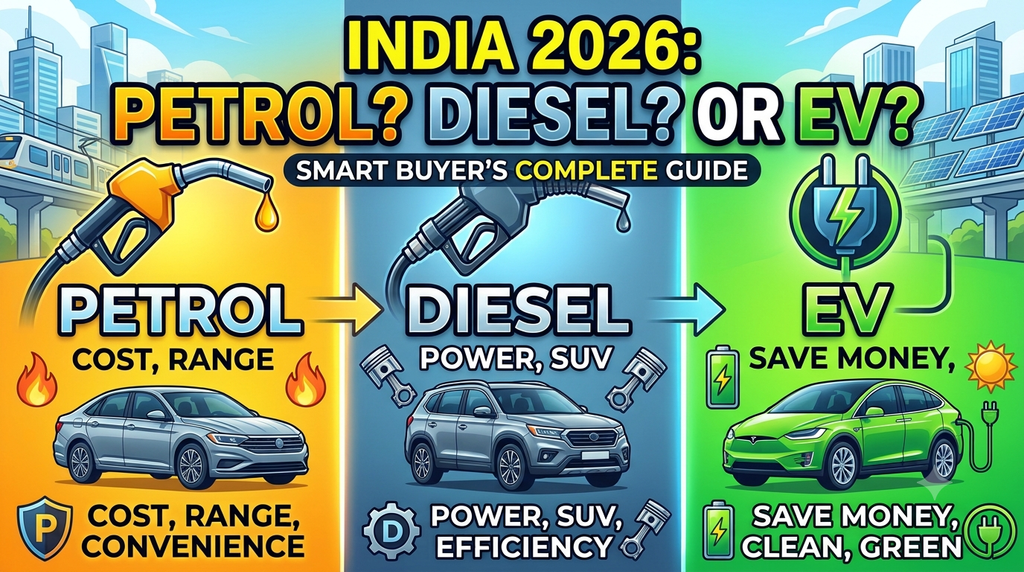
Petrol vs Diesel vs EV :
Buying a car in India has never been this confusing. Fuel prices keep changing, EV charging networks are growing fast, and diesel options are slowly shrinking in showrooms. If you are standing in a dealership wondering what to choose, you are not alone. In this guide, we break down Petrol vs Diesel vs EV in simple language, covering running cost, comfort, maintenance and resale value, so you can pick the right car for your lifestyle and budget.
1. The True Cost of Ownership: What Will You Really Pay?
Running cost is where most buyers make their decision. A petrol car in city traffic usually costs around ₹7 to ₹9 per km. Diesel is cheaper, at roughly ₹5 to ₹6 per km, because of better mileage. An electric car charged at home can cost just ₹1 to ₹1.5 per km, which is a huge saving.
Public fast chargers cost more, but even then most EVs still beat petrol on daily expenses. If you drive 40 to 50 km a day, an EV can save you ₹60,000 or more every year. Diesel makes sense only for very high usage, like 1,500 km or more per month. For light users, petrol remains the simplest and cheapest car to buy.
2. Performance, Comfort and Driving Experience
Petrol engines are smooth, quiet and easy to drive, which makes them perfect for city use. Diesel engines give strong pulling power and excellent highway mileage, but they are noisier and vibrate more at idle.EVs are the winners in comfort. They are silent, deliver instant torque and need no gear changes, so stop-and-go traffic feels effortless. The main concern is range. Most EVs give a real-world range of 250 to 400 km, which is enough for daily use but needs planning for long highway trips. If you often travel between cities, check the charging network on your route first.
3. Quick Comparison Table: Petrol, Diesel and EV
| Factor | Petrol | Diesel | Electric (EV) |
| Purchase Price | Low | Medium to High | High |
| Running Cost per km | ₹7–9 | ₹5–6 | ₹5–6 |
| Maintenance | Moderate | High | Very Low |
| Highway Comfort | Good | Excellent | Good (range matters) |
| City Driving | Excellent | Average | Excellent |
| Pollution | Medium | High | Zero tailpipe |
| Best For | Low to medium usage | Heavy highway usage | Daily city commute |
Figures are approximate and vary by city, model and driving style.
4. Maintenance, Resale Value and Who Should Buy What
Petrol cars have affordable servicing and spare parts available everywhere. Diesel cars cost more to maintain because of turbocharger, filter and emission system upkeep. EVs have far fewer moving parts, so servicing is cheap, and the battery warranty is usually 8 years.
Resale is where things differ. Petrol holds steady value, diesel resale is getting weaker because of tightening emission rules, and EV resale is improving as buyer trust grows.
So who should buy what? Choose petrol if your usage is low and budget is tight. Choose diesel only if you cover very long distances every month. Choose an EV if you have home charging and drive daily in the city.
Frequently Asked Questions (FAQ)
Q1. Is an EV really cheaper than petrol in India?
Yes, in running cost. Home charging makes it several times cheaper per km, though the upfront price is higher.
Q2. Is diesel still worth buying in 2026?
Only if you drive over 1,500 km a month. For most people, petrol or EV makes better financial sense.
Q3. How long does an EV battery last?
Most batteries last 8 to 10 years or more, and manufacturers usually offer an 8-year warranty.
Q4. Which is best for a first-time car buyer?
Petrol, because of its lower price, easy servicing and wide availability.
Conclusion
There is no single winner in Petrol vs Diesel vs EV. Petrol suits light and budget-friendly use, diesel suits heavy highway runners, and EVs suit daily city drivers who can charge at home. Think about your monthly kilometres, charging access and budget before you decide. Take a test drive of each type, because the right car is the one that fits your routine, not the one that is simply trending.
Disclaimer
This article is for general information only. Prices, mileage and running costs are approximate and may vary by city, model and time. Please verify details with official dealers before buying.



Leave a Reply