Ultimate Comparison: Electric Vehicle Maintenance Costs vs Gas Cars
By Kaushik Brahmakshatriya
Published On 01 October 2026.
Electric vehicle maintenance costs vs gas cars :
Introduction
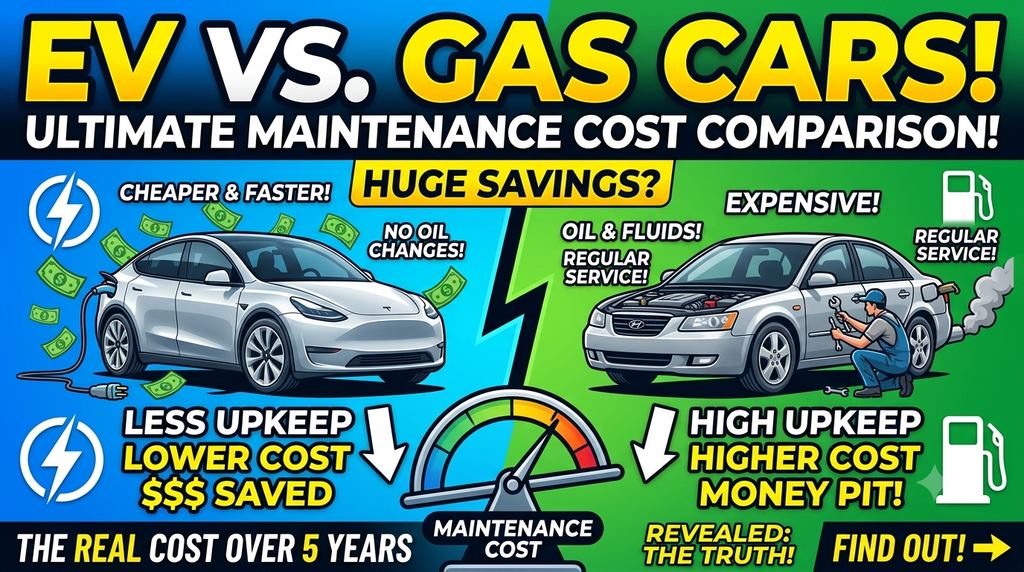
When buying a new vehicle, most drivers focus heavily on the sticker price, but the real financial impact comes from long-term upkeep. Comparing electric vehicle maintenance costs vs gas cars reveals a massive difference in how much money stays in your wallet over time. Traditional gasoline vehicles rely on complex internal combustion engines with hundreds of moving parts that wear down continuously. In contrast, electric cars operate on simple battery-powered motors that require far less mechanical upkeep.
Why Electric Cars Cost Significantly Less to Maintain
Electric cars do not have internal combustion engines, meaning dozens of routine mechanical head-aches vanish instantly. When analyzing electric vehicle maintenance costs vs gas cars, the primary reason EVs come out ahead is component simplicity.
Gasoline vehicles require regular service intervals for engine oil replacements, oil filter swaps, spark plug changes, timing belt updates, and transmission fluid flushed every few thousand miles. An EV uses a battery, an inverter, and an electric motor with only a fraction of moving parts. You will never need to pay for an oil change, an exhaust pipe repair, or a clutch replacement again.
The Role of Regenerative Braking and Fluid Maintenance
Another major factor favoring electric cars is regenerative braking. When you lift your foot off the accelerator in an EV, the electric motor reverses direction to slow the car down, acting as a generator to feed power back into the battery.
This process handles most everyday deceleration without forcing the physical brake pads against the brake discs. Because traditional friction brakes are rarely stressed, brake pads on an electric vehicle can easily last up to two or three times longer than those on a gas car. While gas cars need frequent brake pad and rotor replacements due to high friction, EVs keep brake wear minimal.
Side-by-Side Maintenance Cost Comparison
To clearly see where your money goes, here is a breakdown comparing common maintenance items for both vehicle types over a typical annual ownership period:
| Maintenance Service | Electric Vehicle (EV) | Gas-Powered Car |
| Engine Oil & Filter Change | Never required ($0) | $60 – $120 per year |
| Brake Pad & Rotor Replacement | Every 80,000+ km (Low Wear) | Every 30,000–40,000 km (High Wear) |
| Spark Plugs & Fuel Filters | None ($0) | $100 – $250 periodically |
| Transmission & Clutch Service | None ($0) | $300 – $800 periodically |
| Tire Wear & Replacement | Slightly higher due to weight | Standard wear rate |
| Average Annual Service Budget | Approximately $400 – $500 | Approximately 800 $-1200 $ |
Where EVs Cost More: Tires and Long-Term Considerations
To evaluate electric vehicle maintenance costs vs gas cars fairly, we must acknowledge the few areas where EVs cost more. Because electric vehicles carry heavy battery packs and deliver instant torque, they place extra stress on tires. EV owners may need to replace tires roughly 20% to 30% sooner than gas car owners if driving aggressively.
Additionally, high-voltage battery health is a key factor. Modern EV batteries come with 8 to 10-year manufacturer warranties, but out-of-warranty replacements can be costly. However, routine ongoing maintenance remains significantly cheaper for EVs year after year.
Frequently Asked Questions (FAQs)
Q1: Do electric cars need any regular servicing at all?
Yes. While EVs don’t need oil changes, they still require cabin air filter changes, brake fluid checks, tire rotations, wheel alignments, and battery coolant inspections.
Q2: How much can I save annually on maintenance with an EV?
On average, drivers save between 40% and 50% on routine mechanical maintenance each year by switching to an electric car over a conventional gas vehicle.
Q3: Why do tires wear out faster on electric vehicles?
EVs are heavier due to their battery packs, and their electric motors deliver instant torque to the wheels, causing higher tire friction during acceleration.
Conclusion
Evaluating electric vehicle maintenance costs vs gas cars shows a clear economic winner for everyday drivers. Gas cars require constant financial outlay for oil changes, exhaust fixes, and frequent brake repairs. Electric vehicles eliminate most moving mechanical parts, resulting in lower annual upkeep, longer-lasting brakes, and fewer service visits. Over several years of ownership, the substantial savings on routine maintenance easily make electric vehicles a smarter long-term investment.
Disclaimer: The cost estimates provided in this article are based on average industry data and standard driving conditions. Actual maintenance expenses may vary based on vehicle model, local labor rates, driving habits, and individual vehicle age.

Related Posts
TVS Apache Electric 2026:
February 6, 2026Best Sunroof Cars Under 10 Lakh in India (2026 List)
August 31, 2026
Leave a Reply